Fibroma Removal in Zug — Safe removal of fibromas in the mouth.

A fibroma in the mouth is usually benign — but it should be carefully assessed and, if necessary, removed. We carry out fibroma removal on an outpatient basis under local anaesthetic, safely and gently.

Fibromentfernung Zug — Fibrom im Mund entfernen beim Zahnarzt

What is a fibroma?

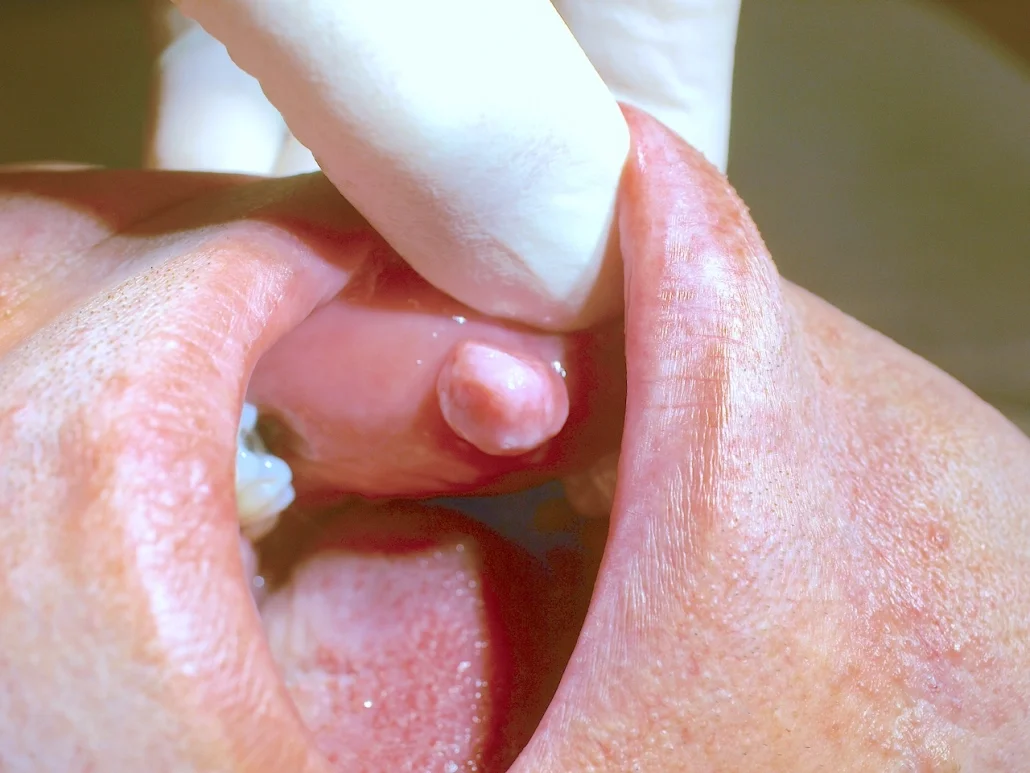
A fibroma is a benign growth consisting of connective tissue. In the mouth, such growths often occur as irritation fibromas — thickening of the mucous membrane caused by chronic mechanical stress. Triggers can include sharp tooth edges, poorly-fitting dentures, pressure points or dental fistulas.

A fibroma in the mouth typically presents as a soft, smooth, well-defined thickening of the mucous membrane — usually on the inside of the cheek, the palate, the gums or the tongue. In most cases, it is non-tender and painless, but its location may cause discomfort when chewing.

When is it necessary to remove a fibroma?

Not every thickening needs to be removed immediately. If the growth regresses on its own once the source of irritation has been removed, it can be monitored. If it persists or grows larger, we recommend removal of the fibroma. Important: Any unexplained change in the oral mucosa should be investigated by a dentist — to ensure that it is indeed a benign fibroma and not a malignant lesion. If in doubt, the removed tissue is examined histologically.

Better safe than sorry: Changes to the oral mucosa that persist for longer than two weeks should always be investigated — even if they are not painful. Early detection is crucial.

The fibroma removal procedure

The removal of this benign growth is a minor outpatient procedure carried out under local anaesthetic. The fibroma is completely excised — that is, surgically removed — from the tissue. The procedure usually takes 15 to 30 minutes. The wound is closed with absorbable stitches, which dissolve on their own. The removed tissue can be sent for histological examination if requested or if there is any uncertainty.

Aftercare

After the fibroma has been removed, the wound site will be tender for a few days. We recommend a soft diet and good oral hygiene. The stitches will dissolve on their own after about 10–14 days. A follow-up appointment once the wound has healed ensures that everything has healed properly and that the cause of the irritation has been eliminated — for example, by adjusting a denture or smoothing a sharp tooth edge.

Preventing the recurrence of a fibroma

The most important thing is to eliminate the original source of irritation. Otherwise, the thickening of the mucous membrane may recur. We will work with you to identify what caused the chronic irritation — and ensure that a relapse does not occur.

Fibroma removal in Zug — Neustadt Passage Dental Practice

Have you noticed an unexplained thickening or swelling in your mouth? Have it checked out. We’ll examine the change carefully and recommend the right next step. Book an appointment at Baarerstrasse 12 in Zug.

Fibroma removal vs. waiting and seeing

Many patients wonder whether they should wait. A small, stable thickening of the mucous membrane that causes no symptoms can be monitored — provided the source of irritation is removed. If the lesion grows, changes colour or shape, or if there is any uncertainty, we recommend surgery. The removed tissue can be examined histologically to rule out any doubt.

Interested? We’d be happy to advise you.

Book an appointment at our practice at Baarerstrasse 12 in Zug.
Cost of fibroma removal in Zug

The costs depend on the size of the thickening and any histological examination required. If medically indicated, basic health insurance may cover the costs. If required, we will provide a cost estimate in advance and keep you fully informed — with no surprises.

Tolerability and safety

Procedures on the oral mucosa are routine in dental surgery. Local anaesthesia ensures the procedure is pain-free; the risk of complications is very low in cases of clearly defined, benign lesions. Following removal, you will receive clear written aftercare instructions. If you have any questions following the procedure, you can contact us by telephone at any time.

Fibroma or denture stomatitis — what’s the difference?

Denture wearers frequently develop changes to the oral mucosa — either due to direct pressure (pressure sores) or chronic irritation (irritation fibromas). In addition, denture stomatitis may occur: an inflammation of the oral mucosa beneath the denture, caused by fungi (Candida). Both conditions look similar but are treated differently. Whilst an irritation fibroma is treated by removal, denture stomatitis requires antifungal medication and denture cleaning. We will make the correct diagnosis and initiate the appropriate treatment.

Histological examination — when is it necessary?

In cases of clearly benign, clinically classic irritative fibromas, a histological examination is not strictly necessary. However, in cases of unclear findings, an unusual appearance or an inconclusive diagnosis, we routinely send the biopsied tissue to the laboratory. The results are usually available within one to two weeks and provide us — and you — with complete certainty.

When to see the dentist — our advice

If you notice a lump, swelling or change in your mouth that has persisted for more than two weeks or is growing: please come and see us. We will examine the area carefully, explain clearly what we see — and recommend the right next step. Quick, straightforward, and without any pressure.

Frequently asked questions about fibroma removal

Fibromas in the mouth are benign in the vast majority of cases. Nevertheless, any unclear change in the oral mucosa should be assessed by a dentist to rule out a malignant condition. If in doubt, the removed tissue is examined histologically.
Yes — if the source of irritation is removed (e.g. a sharp tooth edge is smoothed down, or a denture is adjusted), a fibroma may in some cases disappear on its own. If it persists, we recommend removal.
The procedure is carried out under local anaesthetic and is therefore painless. Afterwards, the wound site may be slightly tender to pressure for a few days — this subsides quickly.
If the original source of irritation is not removed, a new fibroma may develop. That is why identifying the cause is just as important as the removal itself.
The wound usually heals completely within 1–2 weeks. The absorbable stitches dissolve on their own. A follow-up appointment once the wound has healed is recommended.
The cost depends on the extent of the procedure and any histological examination that may be required. If medically indicated, basic health insurance may cover the costs. We will provide you with transparent information in advance.