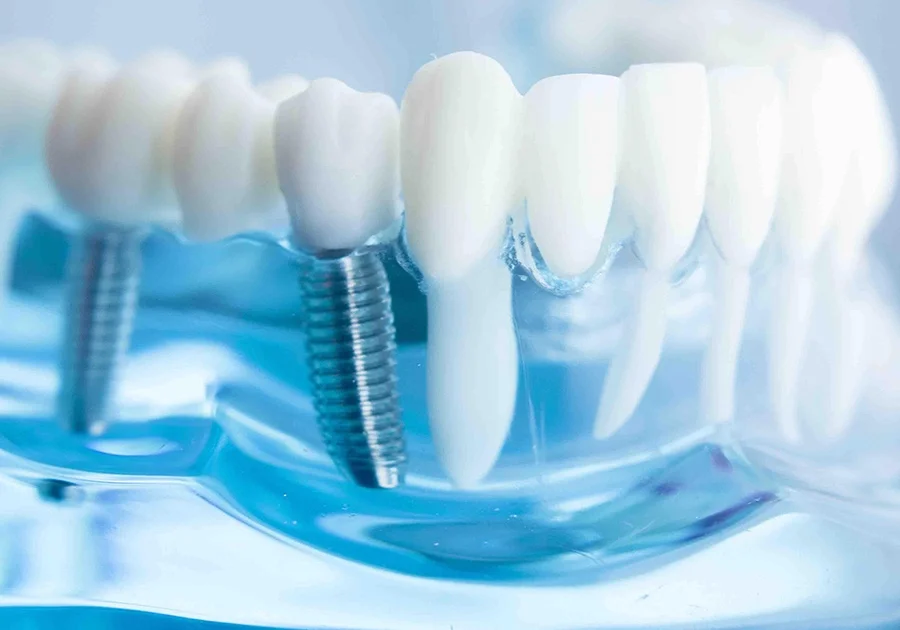
What is a dental implant?
A dental implant is an artificial replacement for a missing tooth root. This small titanium screw is inserted into the jawbone, where it serves as a stable foundation for a crown, bridge or denture. Over the course of a few months, the artificial root fuses with the surrounding bone — a process known as osseointegration. The result: a firm, durable dental restoration that feels and behaves like a real tooth in everyday life.
Titanium is the material of choice because it is biocompatible, does not trigger allergic reactions and bonds permanently with the bone. The excellent biocompatibility of this material has been scientifically proven on numerous occasions.
Who is a dental implant suitable for?
A dental implant is suitable for any adult whose bone growth has ceased and who has lost one or more teeth. Sufficient bone volume in the jaw area is crucial. If bone loss is present, bone augmentation may be possible in some cases before the implant is placed. General medical conditions such as diabetes or blood clotting disorders, as well as heavy smoking, can affect the prognosis for healing — we will discuss these factors openly with you during your consultation.
The implant treatment process
The procedure itself is carried out under local anaesthesia and takes between 30 and 90 minutes, depending on its extent. We insert the dental implant into the prepared jawbone and close the wound. During the healing phase, which lasts around two to four months, the titanium fuses with the bone. Afterwards, the abutment is attached and finally the permanent crown is fitted. The entire treatment takes several months — but the result is long-lasting and stable.
Applications
Once the dental implant has fully healed, it can be used in various ways. It can support a single ceramic crown where a single tooth is missing, anchor a bridge where several teeth are missing, or serve as a secure anchor for a removable denture. Even in a completely edentulous jaw, four to six strategically placed implants enable a fixed restoration.
Advantages over conventional dental prostheses
A dental implant preserves the neighbouring teeth, as – unlike a bridge – there is no need to grind down healthy neighbouring teeth. It stimulates the jawbone and thus prevents bone loss, which inevitably sets in following tooth loss. Quality of life improves noticeably: speaking, chewing and laughing are once again possible without restriction — and without the fear of dentures slipping out of place.
Cost and durability
A dental implant is an investment — but a long-term one. With good care and regular check-ups, implants last for decades, and in many cases for a lifetime. The costs depend on the number of implants, the type of restoration and any necessary bone grafting. In Switzerland, basic health insurance does not cover the cost of implants; supplementary insurance may cover part of the cost. We provide you with transparent information in advance.
Dental implants in Zug — Neustadt Passage Dentists
Would you like to know whether a dental implant is suitable for you? Book a consultation at our practice at Baarerstrasse 12 in Zug — we’ll assess your situation and explain all your options with no pressure.
What should I bear in mind after treatment?
Following the placement of the artificial tooth root, the first few weeks are crucial for proper healing. Avoid smoking — nicotine impairs blood circulation and significantly increases the risk of rejection. Eat soft foods for the first few days and avoid putting unnecessary strain on the surgical site. To look after your new restoration, we recommend the same care as for natural teeth: brushing twice a day, flossing, and a professional clean every six months.
Interested? We’d be happy to advise you.
Book an appointment at our practice at Baarerstrasse 12 in Zug.