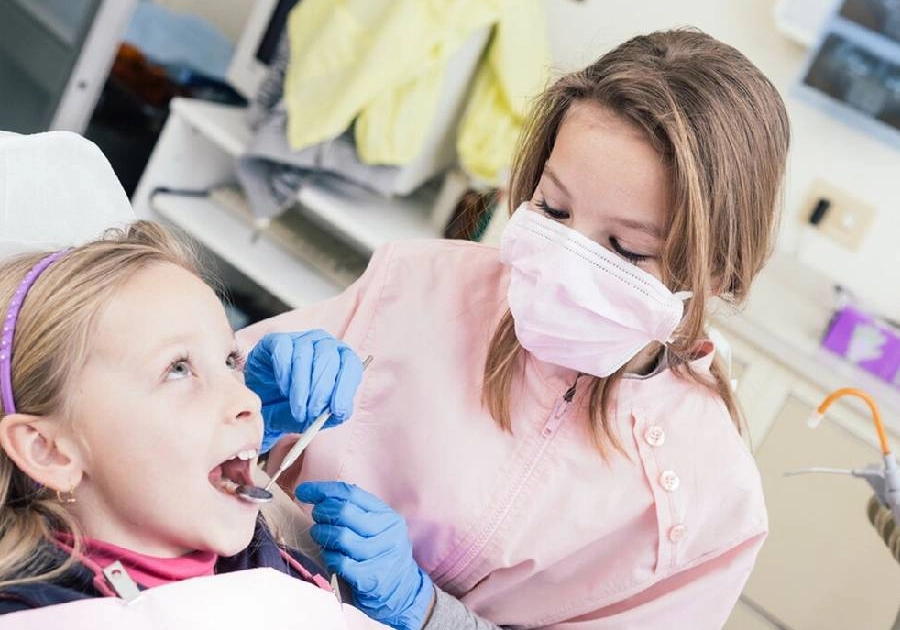
Paediatric Dentistry in Zug — why start early?
Children’s dental health lays the foundation for a healthy set of teeth in adulthood. Milk teeth are not just placeholders for the permanent teeth — they are crucial for chewing function, speech development and children’s self-confidence. Neglecting milk teeth not only risks tooth decay and pain, but also misalignment of the permanent teeth.
As paediatric dentists in Zug, we place great importance on creating a child-friendly atmosphere. No child should leave our practice feeling unhappy — that’s why we take our time, explain everything in simple terms and proceed at your own pace.
Our services in paediatric dentistry
Oral hygiene advice
We show your child how to brush properly and thoroughly — in a way that’s suitable for their age, using the right technique and the right tools.
Fluoridation
A special fluoride varnish strengthens the enamel of milk teeth and protects against tooth decay — which is particularly important as milk teeth have thinner enamel.
Fissure sealing
The deep grooves in the molars are often difficult to clean properly. We seal them with a thin layer of plastic that keeps tooth decay-causing bacteria at bay.
Nutritional advice
Sweets don’t have to be off-limits — we’ll explain to you and your child how to ‘snack sensibly’ and what really damages teeth.
School dental check-up
As a registered paediatric dentist in Zug, we carry out the statutory school dental check-ups — for all school-age children in the canton of Zug.
Nitrous oxide for children
For anxious children, we offer nitrous oxide — a gentle, fast-acting method to make treatment more comfortable.
When should you take your child to the paediatric dentist?
We recommend the first visit to the paediatric dentist as soon as the first milk teeth appear — this is usually between 6 and 12 months of age. This first appointment is not a ‘proper’ dental visit, but rather an introductory session: we take a look at the first little teeth, advise parents on proper care and ensure a positive first experience of the practice.
From nursery age onwards, we recommend check-ups every six months — so that we can detect tooth decay or misalignment at an early stage and gently address the issues.
A child-friendly atmosphere in our practice
We know that a child’s first visit to the dentist can be a formative experience — for better or for worse. That’s why we take extra time with children. We explain every step in child-friendly language, show them the instruments before we use them, and listen for signs that a child needs a break.
Even anxious children are welcome here — it often helps to simply visit the surgery first, without any treatment taking place straight away. Building trust is just as important to us as the treatment itself.
Tip for parents:
Talk positively about the dentist’s appointment at home — avoid words like ‘drill’ or ‘injection’ and emphasise instead that it’s just a check-up. Children pick up on their parents’ attitude.
Paediatric dentist in Zug — Zahnärzte Neustadt Passage
Our practice at Baarerstrasse 12 in the centre of Zug is easily accessible for families. We look forward to supporting your child on their journey to healthy teeth — from their first milk teeth right through to the transition to adult dentistry.
Book an appointment for your child
We support your child with patience and empathy — right from the start.